
In this Article:
Try Kanbanchi now
Start your free trial

Enterprise Project Management (EPM) is a coordinated approach that helps businesses manage complex projects more effectively. It is typically seen in large companies that are keen to organize their efforts more effectively. What benefits does this bring, and what kind of business should be looking to make the change?
Think back to the last time your SME started a new campaign. Was it all plain sailing, with every department coordinating neatly towards the final goal? Or did it feel like a series of disconnected tasks connected to a disparate bunch of team members, each using different tools, different metrics, and different definitions of success? In the world of scaling SMEs, there’s a massive, often invisible gap between the high-level vision discussed in the C-suite and the daily tasks being checked off in the trenches.
At its simplest, EPM is the practice of managing projects at an organizational scale. But it’s much more than just project management when you look at it closely. While traditional project management focuses on the successful delivery of a single project, EPM focuses on the health, alignment, and ROI of your entire portfolio, top-down.
In Kanbanchi’s comprehensive guide, we’re going to pull back the curtain on:
To understand EPM, we first have to distinguish it from the project management we all know. It’s also clear that the two methods remain essential, but they require entirely different skill sets and perspectives.
It’s probably easiest to think of these two ideas as micro and macro tools. But let’s dive a little deeper. Traditional project management is tactical. It’s concerned with three constraints: time, scope, and cost. The project manager’s win will be finishing their project within the parameters. That’s a micro view.
EPM, however, is strategic. It looks across multiple projects simultaneously. Then it asks questions on the intersection of all projects. It’s a macro view that prioritizes the organization over individual tasks.
| Traditional PM | Enterprise Project Management |
|---|---|
| Time | Does the delay in Project A risk the budget for Project B? |
| Scope | Does the delay in Project A risk the start of Project C? |
| Cost | Do we have enough resources to support all three? |
In traditional project management, teams often choose their own approach to management. One team prefers Trello, another prefers a spreadsheet, and the developers use Jira.
In an EPM environment, this fragmentation is a deal-breaker. Enterprise Project Management needs a unified way to manage everything. Now, this doesn’t mean micro-management; it means standardization.
Think about it like this. When an executive reviews a report from Marketing and one from IT, they are viewing the same KPIs, status levels, and financial metrics as the rest of the team, and it’s all easy to understand and get to grips with.
Within these two types of management tools, how do teams recognize a win?
Traditional project management focuses on one goal. EPM forces projects to prove their worth: if a project is no longer aligned with a high-level business strategy, EPM provides the framework to pivot or terminate the project, even if it’s on time.
Here’s a handy guide to the key differences between the two methods.
| Traditional Project Management | Enterprise Project Management | |
|---|---|---|
| Focus | Tasks/Deadlines | Business Value/ROI |
| View | Vertical (within the team) | Horizontal (across the organization) |
| Resources | Dedicated to one project | Balanced across the portfolio |
There’s no hard-and-fast rule for when to transition from traditional PM to EPM; it typically occurs when a company moves from a startup mindset to an enterprise mindset that breeds continuous success.
It’s a transition that requires the right people, the right processes, and, critically, the right software.
Thinking ahead, what are the most effective elements of a great enterprise project management system? We’ll take a look at these in the next section.
Read more of our blogs on Project Management
Implementing Enterprise Project Management isn’t about buying a tool and flipping a switch. You’re setting yourselves up to fail if you think like that.
More, it’s about building a structure that can support the weight of an entire organization, week in, week out. Not only that, it’ll be able to scale up (and scale down) when needed.
Think of these pillars as the operating system for your company’s productivity. If one is weak, the entire strategy leans. What are they, and how can they be used?
Governance provides your project roadmap. It defines:
In an EPM framework, governance ensures that the leadership team has a clear Go/No-Go process for every initiative.
You can’t compare apples to oranges. Standardization means every department follows a unified lifecycle, from the initial proposal to the final post-mortem.
When workflows are standardized, team members can move between projects without having to learn a whole new language or system.
This is often the most significant pain point for large companies. EPM gives you a bird’s-eye view of your human capital.
Instead of guessing who is busy, you can see real-time availability across the entire project. This prevents a hero culture in which the same three people are assigned to every high-priority task, which can lead to burnout.
While EPM is high-level, it must still support day-to-day operations. This pillar focuses on the tools and methodologies (e.g., Agile, Waterfall, or Hybrid) used to complete the work.
The goal here is consistency; every project should have a clear path from a backlog to Done.
How good is your organization at managing projects? EPM involves constant self-assessment. By measuring your PM maturity, you can identify where you need more training, better tools, or more refined processes. It’s a commitment to improving by 1% every day.
Consider these five pillars before deciding on your next steps. Then you can decide whether you really need enterprise project management software. If you’re not sure, we’ll outline the core reasons you may need it in the next section.
Traditional project management techniques and methodologies remain popular among many companies across industries. While there are powerful reasons to work this way, issues can arise as a business grows. As it grows more complex, conventional methodologies may become cumbersome and difficult to coordinate.
By switching to enterprise project management, it becomes easier to take an overall approach that accounts for factors such as risk analysis and data analytics. It also covers how we can best use our resources through proper scaling practices and accurate progress tracking.
Essentially, it prevents your resources from being spread too thinly and without any real coordination. The enterprise method consolidates everything in one place. Therefore, it is easier to see the full picture at all times.
One of the key benefits here is the way data is gathered to enable faster, easier analysis across projects. Rather than working independently in a traditional project setting, the project managers can collaborate. They can connect as needed and access all relevant data.
It also ensures a consistent approach to projects across multiple teams. Even if you have a variety of different project managers working on different things, they will all use the same methods, meaning that moving people about or replacing them becomes less troublesome.
As we have seen, this method of running better projects is ideal for larger companies and those with complex needs. However, this doesn’t mean that smaller businesses can’t also benefit from it.
This way of working allows any sort of company of any size to improve its project work. This is achieved by streamlining the process and working in a more coordinated way at all times. Even on smaller and less complex projects, having a better understanding of the resources being used is a great idea.
A more modestly sized business can have issues due to project managers taking different approaches, just as a bigger company can. One or more of them might not have fully understood or accepted the company vision. Some of them also may stick to processes that have worked for them elsewhere but aren’t right for your company.
Naturally, making the move to enterprise project management is also a way of setting up the business to face the future too. If you expect it to grow over time, then putting the right processes in place early on will help you to expand more smoothly later on.
Perhaps the key to understanding this subject better is in seeing how enterprise project management allows you to bring all of your projects together to a point where you can see the overall big picture more easily.
You will be overseeing various projects at once. It means easy access to the data that you need to make solid, informed decisions on issues such as the resources needed for each one. This lets you understand how they all link together while keeping each project clearly defined in its own right.
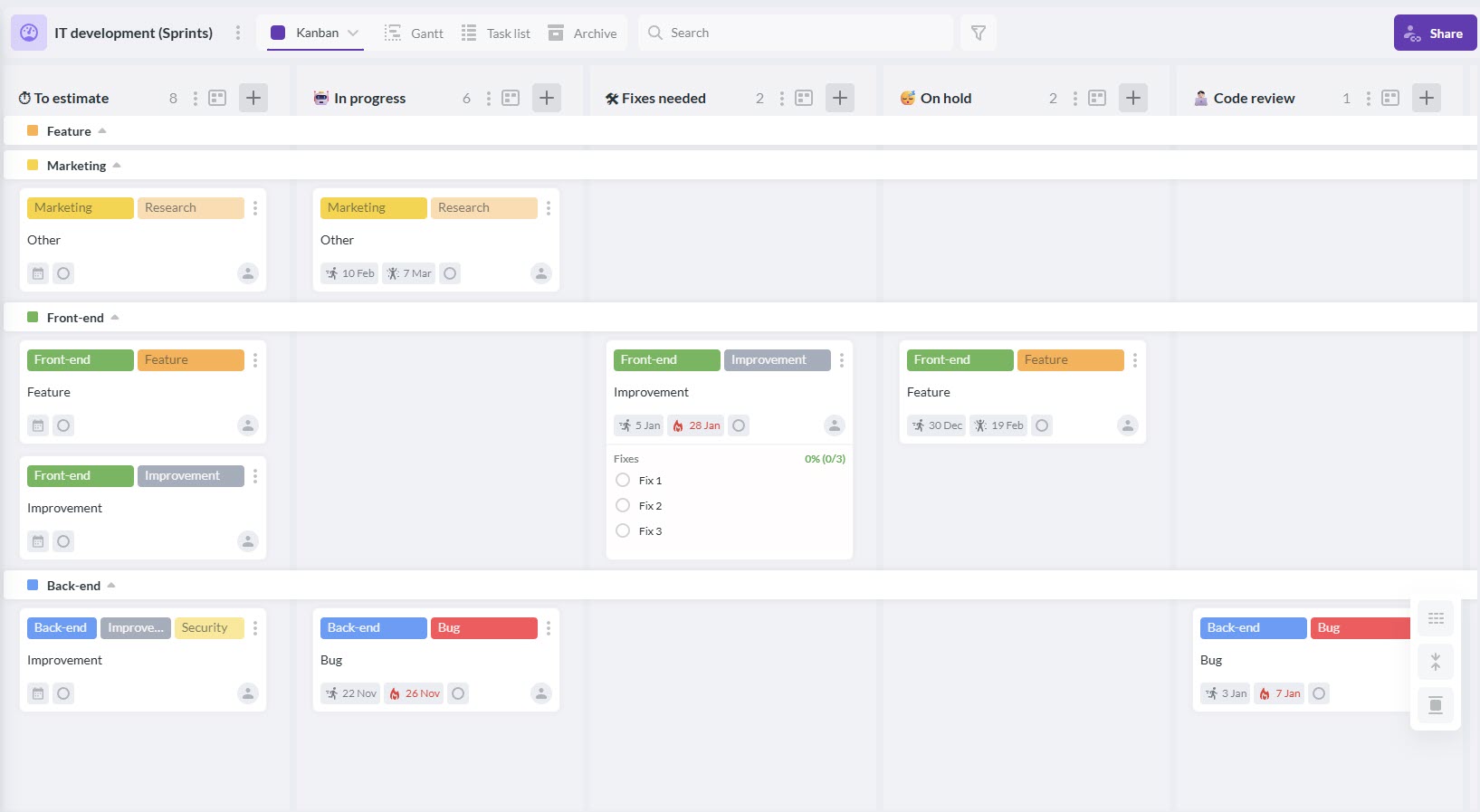
In Kanbanchi, you can use swimlanes to stack different projects or teams on one board
One of the first steps in doing this well is setting up a project management office. This will help you centrally coordinate all the projects you run and the resources required for them.
The next step is to assess the software you need to bring this way of working to life. By choosing the right software, you will get the tools that you need to make this switch a success.
If you try to run an EPM strategy using only basic tools, you will eventually hit a brick wall that’s impossible to knock down, no matter how hard you try. It’ll mostly consist of data backlogs that come from multiple sources.
Also known as data silos, they occur when information is trapped:
In an enterprise environment, these silos are a silent killer. They lead to duplicated work, conflicting data, and expensive delays.
It is a centralized platform that serves as the company’s single workspace. If you like, it’s the digital equivalent of an Air Traffic Control tower. It doesn’t just track tasks; it also tracks relationships between projects, budget allocation, and the health of the business strategy.
We’ve all seen the Master Spreadsheet! The one with fifty tabs and broken macros that only one person knows how to fix. While spreadsheets are great for data entry, they are terrible for collaborative oversight. EPM software automates the reporting that typically requires hours of manual spreadsheet manipulation.
At the enterprise level, information ages like milk, not wine. If an executive reviews a report manually compiled last Friday, they are making decisions based on stale data. EPM software provides real-time updates. If a deadline slips on the factory floor, the CEO sees the impact on the quarterly goal instantly.
The paradox of growth is that as a company gets larger, it often gets slower. EPM software reverses this trend by scaling with you as you build your brand. Once you use EPM to automate the busywork of project tracking, your teams can focus on innovation rather than just managing their to-do lists. It saves time, burnout, and money.
Why bother with the shift to EPM? It sounds like a lot of heavy lifting for some gain. But the data doesn’t lie: companies that master enterprise-scale management see a dramatic shift in their bottom line. It’s not just about staying organized. It’s about building a more resilient, profitable business.
Organizations waste an average of 10-12% of every dollar due to poor project performance. EPM ensures that every project actually supports a corporate objective. If a project doesn’t move the needle on your current goals, EPM gives you the data to stop it and reallocate those funds elsewhere.
In a siloed company, some teams are drowning in work while others have light weeks.
EPM provides a heat map of your team’s capacity. You can identify who is overallocated across five projects and reallocate tasks to people with more bandwidth.
This reduces burnout and sustains momentum.
At the enterprise level, a delay in one department can cause a bullwhip effect across the entire supply chain.
EPM identifies these dependencies early. You’re no longer reacting to crises; you’re anticipating them weeks in advance.
When everyone uses the same system, you stop having meetings to prepare for the meeting.
There’s no need to email status updates when the status is visible on a project board. This clears the schedule for what really matters: high-value execution.
So, that’s the “why” sorted. Now, let’s look at a software solution that can make all the difference for your EPM needs as you scale up.
If your organization is already powered by Google Workspace, you face a unique challenge. Most EPM tools feel like outsiders. They require new logins, separate storage, and a steep learning curve. Kanbanchi is the exception to this. It is the only enterprise-grade project management tool built inside the Google ecosystem. Already using it? Then there’ll be no downtime and little to no new learning curve for you. For many, that’s a big win.
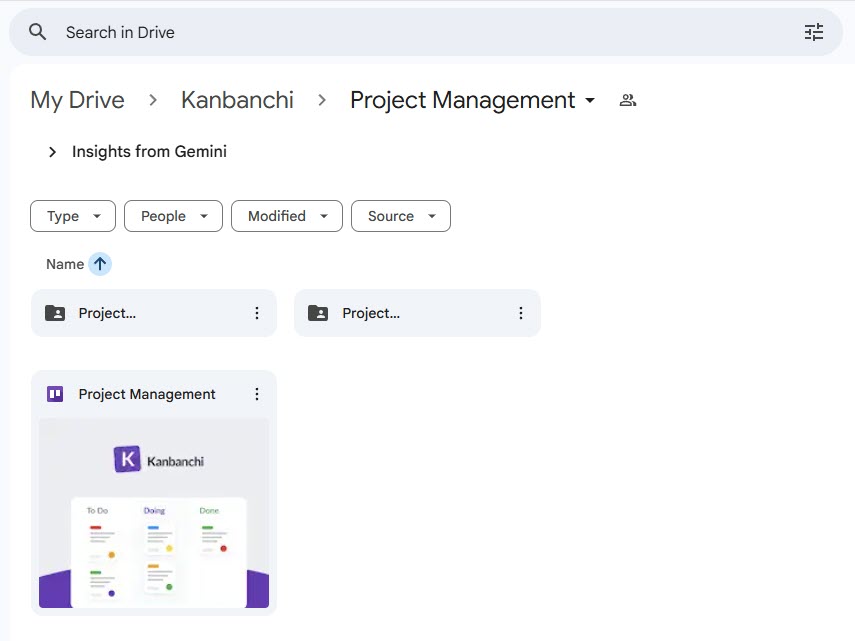
Avoid the security risks and “outsider” feel of third-party platforms by choosing enterprise project management software that stores your project boards directly within your existing Google ecosystem
START A FREE TRIAL WITH KANBANCHI
If your company relies on Microsoft products, there’s still the same need for an application that can integrate into your familiar set of tools.
For the enterprise, security isn’t just a checkbox; it’s the foundation. Kanbanchi lives inside your Google Drive, OneDrive or SharePoint. This means your project data stays within your organization’s controlled environment. You don’t have to worry about another third-party cloud provider holding your sensitive data. It stays the same no matter how many projects you’re juggling.
One of the highest costs of EPM implementation is training. Because Kanbanchi looks and feels like a native Google app for Google users and has an intuitive interface for Microsoft users, your team will get it in minutes, not weeks. This high adoption rate is the secret to a successful rollout. It makes sense to invest in a tool that’s ready to go from the outset.
When you attach a file to a Kanbanchi card, you’re linking directly to Google Drive, OneDrive, or SharePoint. When you set a deadline, it reflects on Google Calendar (for Google Workspace users). It’s a seamless loop that keeps your enterprise data consistent across every single tool your team uses daily.
Everyone knows what they’re doing and when. If one task deadline changes, everything updates automatically. This seamless transition makes workflows much easier to manage and ensures your projects (however many you’re juggling) stay on track.
Also, there are many other powerful integrations, like having Kanbanchi boards on the SharePoint sites (Microsoft) or one-click conversion of email to Kanbanchi card (Google).
By choosing a solution like Kanbanchi, you aren’t adding another tool to your stack; you’re getting everything you need in one place. There’s nothing new to learn, no extensive downtime, and no developers needed to install. Your team will get the power of Kanban and Gantt charts, but with the familiarity of a Google Doc or Word. Everyone gets the security of Google Drive or OneDrive, but with the organization of a professional EPM suite.
If you’ve been considering making the switch from a bunch of disconnected tools that lead to confusion, delays, and missed deadlines, then there’s never been a better time to invest in Kanbanchi. Turn every project into a complete success.
By now, you should have a better idea of what your requirements are when it comes to investing in EPM software for your team. If we’ve missed anything, or if you’d like to summarize the information, here are a few frequently asked questions about the topic.
Traditional project management is tactical and focuses on delivering a single project on time. Once that’s out of the way, the team moves on to the next endeavor and starts the process again. EPM is strategic, focusing on the entire project portfolio and its alignment with business goals over time.
The EPMO is responsible for maintaining standards, governance, and high-level reporting across all projects within the organization.
It breaks down data silos, provides real-time visibility for executives, and ensures balanced resource allocation across departments.
When you’re thinking about making the change, consider the above points and what your team’s future goals are likely to be. If you’re an SME likely to scale up over the next year or two, EPM will be worth your time.



In this Article:
Start using Kanbanchi now
Start your free trial