
In this Article:
Try Kanbanchi now
Start your free trial


Google Workspace is where many teams already communicate, store files, schedule meetings, and write documents. The challenge starts when work becomes too complex for scattered emails, comments, spreadsheets, and personal to-do lists. At that point, business owners and team leads need a task manager that fits naturally into Google Workspace while adding the structure required for real project execution.
To understand what that looks like in practice, it helps to start with what your team actually needs from this kind of software – and then look at where native Google tools fall short.
A task manager needs to meet all of a project’s needs at every stage the work goes through.
Planning is the first critical element. This is a crucial part of any project, and it is easy to make mistakes if you do not have a way of easily seeing all the information and taking past performance into account. A good planning tool lets you link tasks and see the data in a way that is easy to understand.
Scheduling comes next. When it comes to assigning the work, you need to know exactly when your team members are available and how different tasks could impact one another. The ideal situation is to be able to visualize the entire project simply, so that you can see how to use everyone’s talents and time to the best effect.
Resource allocation follows from there. Proper resource allocation means that you have the right people doing what most suits their skills at the right times. Without a tool that gives you both an overall view of the project and a detailed look at each person’s workload, this area can become hugely problematic. Getting it wrong leads to inefficiency and a dissatisfied team.
Time and task tracking are also essential. This is how you can make sure that work is on track and that there are no upcoming problems – confirming that everyone is working effectively and that tasks will be completed on time.
Reporting matters for leadership and stakeholder visibility. A task manager should help you communicate what is going well and where improvements could be made.
Finally, any strong task manager should boost the culture of collaboration across the team. Whether team members need to work together closely on a task or simply need to understand what is happening elsewhere, this capability is increasingly important as more teams operate remotely.

Google Workspace includes helpful task-related tools. Google Tasks can work well for individual reminders, simple to-dos, and personal follow-ups. Google Calendar helps schedule time-sensitive work, Gmail keeps requests moving, and Google Sheets can be adapted into lightweight trackers.
For simpler projects, this combination may be enough. Docs and Sheets give your team a place to note tasks and share updates. Calendar helps with planning and scheduling. Drive provides secure cloud storage for documents. Google Chat and Gmail support team communication.
However, as more people get involved and the scope of work increases, the lack of a dedicated project management tool becomes more noticeable. You end up pulling together a makeshift solution that meets part of your needs but not others.
Team task management has different requirements than personal organization. A manager needs shared visibility, task ownership, statuses, workload awareness, dependencies, reporting, and a reliable way to connect tasks with project files. That is why many teams search for a dedicated Google Workspace task manager when native tools no longer provide enough structure.
The best tools do not replace Google Workspace. They extend it by turning disconnected work into a coordinated system.

The most important feature of any Google Workspace task manager is deep integration. If your team lives in Gmail, Drive, Calendar, Docs, Sheets, and Meet, your task management tool should connect to those workflows instead of forcing people to duplicate information elsewhere.
A useful task manager should allow teams to attach Google Drive files, create tasks from emails, sync dates with Google Calendar, and share work according to existing company access policies. This reduces friction because people can keep using familiar tools while gaining better project visibility.
A visual board is one of the simplest ways to understand work at a glance. Instead of reading through long lists or searching email threads, teams can see tasks as cards moving through workflow stages such as To Do, In Progress, Review, and Done.
Kanban boards are especially useful because they make status visible without requiring long meetings. A team lead can quickly identify bottlenecks, overloaded stages, overdue tasks, and work waiting for approval. Team members can see priorities and next steps without asking for constant updates.
For Google Workspace teams, a visual board is often the missing layer between conversations and execution.
Every task should have one clear owner. Shared responsibility often sounds collaborative, but in practice it can create confusion. A task manager should make it easy to assign work, set deadlines, mark priorities, and show who is accountable for the next action.
Priorities are especially important for business owners and managers overseeing several projects at once. Without priority labels or sorting, teams may spend time on visible but low-impact tasks while urgent work waits. A good task manager helps teams separate what is important from what is merely active.
Due dates should also be visible in different contexts. A task date on a card is helpful, but managers often need to see the same information on a calendar, list, or timeline.
Real work rarely fits into a short title. A business task may include a brief, files, approvals, comments, dependencies, subtasks, and a checklist of smaller actions. Your task manager should provide enough structure to keep all of this information in one place.
Checklists are helpful for repeatable work, such as onboarding, content production, client delivery, finance approvals, or operational reviews. Subtasks or subcards are useful when one deliverable needs to be broken into smaller pieces assigned to different people.
This matters because teams do not just need to know that a task exists. They need to know what “done” means.
Task-related communication should stay connected to the task itself. When updates live only in Gmail or chat, important decisions become difficult to find later. A good task manager gives teams a place to discuss the task, ask questions, record decisions, and notify the right people when changes happen.
Notifications should be useful, not overwhelming. The goal is to alert people about relevant updates, due dates, mentions, and board changes without creating another noisy inbox.
Kanban boards show workflow status, but managers also need to understand time. When multiple tasks depend on each other, a timeline or Gantt chart becomes essential.
A Gantt chart helps teams see start dates, due dates, task duration, milestones, and dependencies. This is particularly useful for campaigns, product launches, operations planning, event delivery, HR initiatives, and client projects.
The most effective tools connect the board and the timeline. When a task changes on the board, the timeline should reflect that change. When a date shifts on the timeline, the task should stay updated. This avoids the common problem of maintaining a Kanban board in one place and a separate spreadsheet timeline somewhere else.
Dates are only useful if people see them where they plan their day. Google Calendar sync is valuable because it brings task deadlines and project events into the scheduling tool many teams already use.
For managers, calendar integration helps coordinate deadlines across departments. For team members, it reduces the risk of missing due dates because project work appears alongside meetings and other commitments.
A task manager should make it simple to add relevant task dates to Google Calendar while preserving the task as the primary source of work details.
Time tracking is not only about monitoring hours. It helps teams understand how long work actually takes, compare estimates with reality, plan capacity, and improve future scheduling.
For agencies, consultants, service teams, and operations departments, time tracking can also support billing, cost analysis, and resource planning. For internal teams, it helps leaders identify recurring bottlenecks and tasks that consume more effort than expected.
A task manager with built-in time tracking is more convenient than using a separate timer because time is recorded directly against the task. This gives managers a clearer view of effort by project, person, or work type.
Read about Google Workspace features that matter most for project teams
For many organizations, Google Drive is the central repository for documents, spreadsheets, presentations, contracts, images, and project assets. A Google Workspace task manager should make it easy to attach files from Google Drive and Shared Drives directly to tasks.
This is important for two reasons. First, it keeps work and supporting documents connected. Second, it helps teams avoid creating duplicate file systems outside Google Workspace.
Important work often starts in Gmail. A client request, internal approval, support escalation, vendor update, or leadership decision may arrive as an email. If that email stays in an inbox, it can easily be forgotten.
A task manager should let users turn emails into tasks quickly. This makes Gmail a practical intake channel without allowing it to become the project management system itself.
Leaders often need reporting beyond the board view. They may want to review workload, completion trends, overdue work, time spent, or project performance in a dashboard.
A useful task manager should allow teams to export data or connect it to reporting tools. Teams can extract data and connect it to reporting dashboards such as Google Looker Studio or another preferred reporting environment.
This helps teams move from “we think we are on track” to evidence-based project tracking.
| Feature | Why it matters for Google Workspace teams |
|---|---|
| Google Drive attachments | Keeps project files connected to tasks without duplicating storage. |
| Gmail task creation | Turns email requests into visible, assignable work. |
| Google Calendar sync | Makes deadlines visible where teams plan their schedules. |
| Google Sheets export | Supports reporting, analysis, and leadership visibility. |
| Shared Drives support | Helps enterprise teams manage boards and files within company structures. |
Business task management requires more than convenience. Teams need confidence that project data is shared with the right people and protected from unnecessary exposure.
A Google Workspace task manager should support internal and external sharing according to company policies. This is especially important for enterprises, agencies, legal teams, education organizations, and any group working with clients, contractors, or partners.
As teams grow, security expectations increase. Leaders should evaluate how a task manager handles authentication, file access, data storage, permissions, backups, and compliance requirements.
The right tool should fit the organization’s governance model rather than creating a separate, unmanaged workspace.
Templates reduce setup time and improve consistency. A team should not have to rebuild the same board structure for every campaign, hiring process, client onboarding, audit, event, or product release.
Look for task managers that support board templates and card templates. Board templates help standardize workflows across teams. Card templates help teams capture repeatable task details, checklists, and required information.
Teams often manage several projects on one board. Swimlanes make it easier to visually separate workstreams while keeping everything in a single view.
For example, a team might use swimlanes for different projects, departments, or process stages. The key benefit is focus: leaders can see the full picture without mixing every task into one long list.
Visual boards are excellent for workflow management, but sometimes managers need a more compact way to review all tasks. A task list view makes it easier to scan, filter, and navigate large volumes of cards from top to bottom.
This is particularly useful for status reviews, planning sessions, and administrative cleanup.
If your team already uses another system, migration should be part of your evaluation. A good task manager should make it easier to bring existing work into the new environment, whether from other tools or from spreadsheets.
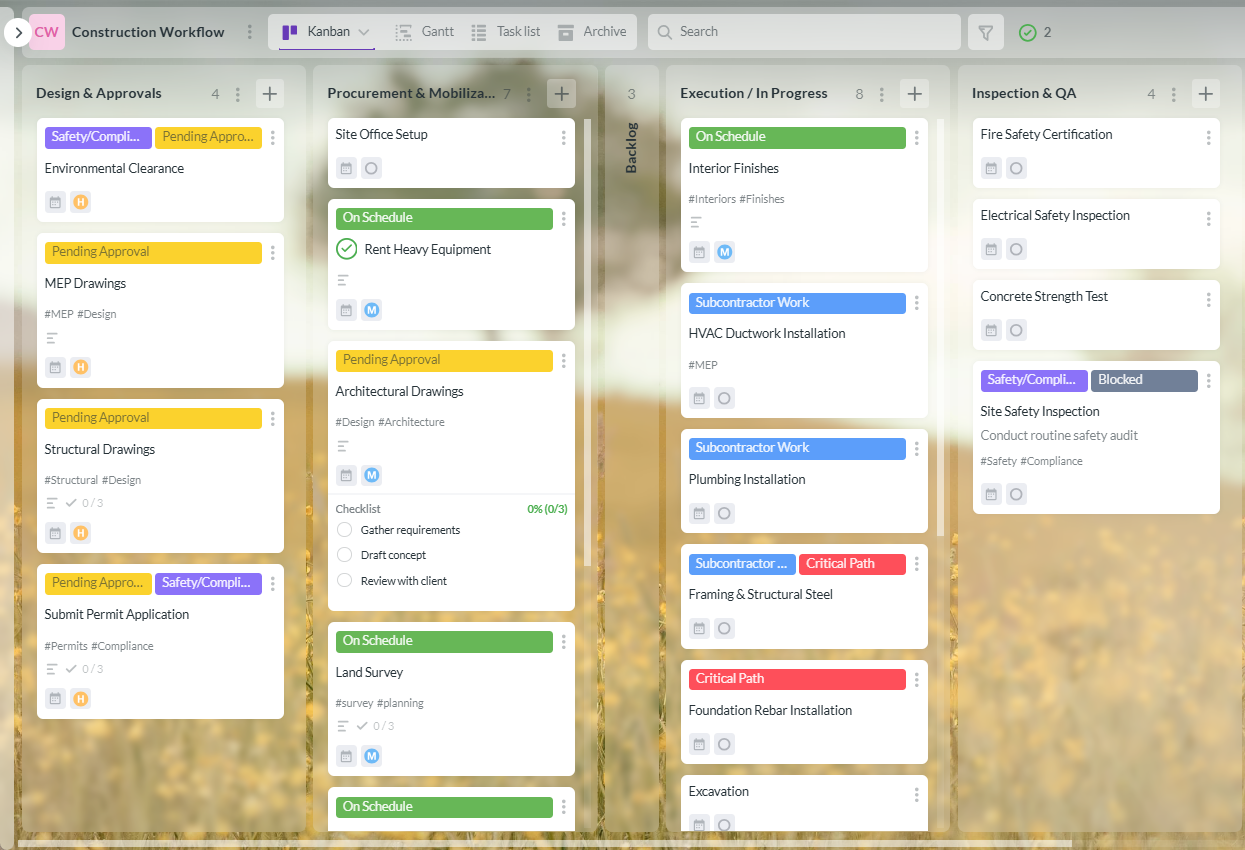
Kanbanchi is an all-in-one project and task management tool designed for Google Workspace and Microsoft 365 teams. Unlike tools built for generic use and then connected to Google via third-party integrations, Kanbanchi is built natively for the Google Workspace environment. Boards live in Google Drive as files, fitting naturally into the storage and sharing model your organization already uses. The interface is also deliberately simpler than competitor tools, which means less onboarding time and faster adoption across the team.

For business owners, the value is that work becomes visible in one place without forcing people out of the tools they already use. Tasks can be organized on Kanban boards, planned on Gantt timelines, connected to Google Drive files, pushed to Google Calendar, created from Gmail, and exported to Google Sheets for reporting.
Kanbanchi combines visual Kanban boards, Gantt chart planning, time tracking, Drive integration, Gmail task creation, Calendar sync, templates, subcards, swimlanes, task list view, and enterprise-level security capabilities – all without the complexity or learning curve of general-purpose project management platforms.
This makes Kanbanchi especially useful for teams that have outgrown spreadsheets or personal to-do apps but do not want to leave the Google Workspace environment, and for business owners who want project visibility without adding tools that fragment how the team works.
Before choosing a tool, evaluate it against the way your team actually works. The best solution is not the one with the longest feature list. It is the one your team will use consistently.
| Requirement | What to check |
|---|---|
| Visual task management | Can the team manage work on Kanban boards with clear statuses? |
| Ownership and accountability | Can tasks have assignees, priorities, due dates, and progress indicators? |
| Project timelines | Is there a Gantt chart or timeline view for deadlines and dependencies? |
| Google Workspace integration | Does the tool connect with Drive, Gmail, Calendar, and Sheets? |
| Collaboration | Can people comment, receive notifications, and share boards securely? |
| Time tracking | Can the team record time directly on tasks? |
| Reporting | Can managers export or analyze task data? |
| Scalability | Will the tool support multiple teams, external users, and enterprise policies? |
| Ease of adoption | Can users understand the workflow without extensive training? |
Native Google tools can be enough for individual task lists, simple reminders, one-person workflows, or very small projects with limited coordination. Google Tasks, Calendar, Gmail, Docs, and Sheets are flexible and familiar.
A dedicated task manager becomes necessary when multiple people need to coordinate shared work, track progress, manage deadlines, attach project files, review workload, or report on performance. If your team spends too much time asking for status updates, searching through email threads, updating spreadsheets manually, or rebuilding timelines, it is probably time to upgrade.
This is also why Google Workspace teams often ask whether there is a built-in project management solution. The short answer is that Google Workspace provides excellent productivity apps, but teams usually need an integrated project management layer for structured execution.
The most important features are Google Workspace integration, visual boards, task assignments, due dates, priorities, file attachments from Google Drive, Gmail task creation, Google Calendar sync, timelines or Gantt charts, time tracking, reporting, and secure sharing.
Google Tasks is useful for personal to-dos and simple reminders. For team task management, most organizations need more structure, including shared boards, ownership, statuses, reporting, and project timeline planning.
Google Workspace includes productivity tools such as Gmail, Drive, Calendar, Docs, Sheets, and Tasks. However, it does not provide a full native project management app with Kanban boards, Gantt charts, time tracking, and advanced reporting.
Google Drive integration keeps project files connected to the tasks they support. This helps teams avoid duplicate storage, reduce confusion, and work within the file-sharing system they already use.
Yes. Kanbanchi is designed for Google Workspace and Microsoft 365, so teams using Microsoft 365 can also manage tasks and projects with visual boards, timelines, and compatible file storage integrations.
Kanbanchi is built natively for Google Workspace, which means boards live in Google Drive as files and the tool follows your organization’s existing sharing and security policies. The interface is also simpler than many enterprise tools, which reduces the learning curve and improves team adoption.
If your team already works in Google Workspace, your task manager should fit that environment naturally. Kanbanchi helps teams plan, assign, track, and report on work using Kanban boards, Gantt charts, time tracking, Google Drive integration, Gmail task creation, Google Calendar sync, and more.
Explore Kanbanchi and give your team a clearer way to manage projects inside the tools they already use.
Sign up for Kanbanchi trial today


In this Article:
Start using Kanbanchi now
Start your free trial